Tuesday, February 26, 2013

News in Brief: Allergy, Asthma and Immunology Meeting

Highlights from the annual meeting of the American Academy of Allergy, Asthma and Immunology, San Antonio, February 22-26, 2013

Highlights from the annual meeting of the American Academy of Allergy, Asthma and Immunology, San Antonio, February 22-26, 2013

By Nathan Seppa

Web edition: February 26, 2013

Promising treatment for years-long hives
People with hives that recur for years and even decades might get relief from an allergy drug. Called omalizumab and marketed as Xolair, the drug inhibits the rogue antibody immunoglobulin E, which brings on persistent, intense itching and body-covering hives in some people. Scientists randomly assigned 323 patients with chronic hives, also called urticaria, to get three shots of the medicine spaced four weeks apart. One-quarter of them got a placebo while the others received one of three doses of the drug. Patients getting the two highest doses experienced substantial declines in itching that lasted until four weeks after the last shot, and 40 percent of the highest-dose group saw their hives disappear completely during treatment, said study coauthor Thomas Casale, an allergist at Creighton University in Omaha, Neb. Twelve weeks after the last shot, symptoms had started to return in most patients. Even so, said allergist and coauthor Allen Kaplan of the Medical University of South Carolina in Charleston, omalizumab could offer respite for patients with chronic hives. Roughly half fail to benefit from antihistamines at some point, as did everyone in this trial. ?Many of us in the field view [omalizumab] as a game changer for these patients,? Kaplan said. The researchers reported the finding February 24 at the meeting and in the New England Journal of Medicine. ?

Allergic kids? growth at risk
Children with an allergy to dairy products weigh less on average than kids who can eat what they want, researchers at the University of North Carolina at Chapel Hill reported February 24. The scientists analyzed medical records of 245 food-allergic children up to age 11 and took note of any food allergies diagnosed from 2007 to 2011. Several allergies showed up? to peanuts, eggs, dairy and other foods. Overall, the children with more than two food allergies were slightly shorter than other children without food allergies. But only allergy to milk was undoubtedly linked to lower body weight, and this association was most striking in children who were younger than two years old, said study coauthor Caroline Hobbs, a pediatrician. Such children should receive special care, she said. ?By that I mean dietary intervention ? referral to a nutritionist or dietary counselor of some sort ? to create diet alternatives.?

Vitamin D may boost hepatitis B shot
Compared to men with low levels of vitamin D, men with high levels might get more out of a hepatitis B vaccination, South Korean researchers reported. Scientists obtained blood samples from 5,025 men after they got immunized against hepatitis B. When the researchers divided the men into groups with low, medium or high levels of vitamin D, they found those in the low group had made much less protective antibody against hepatitis than did those in the high vitamin D group, Ju-Suk Lee of Sungkyunkwan University in Changwon reported on February 23. The findings jibe with other evidence that vitamin D helps regulate immune function. Men who smoked, were older, had diabetes or were heavier also had a muted response to the vaccine. Taken together, the analysis suggests that those factors might have a stronger negative effect on vaccination benefit than low vitamin D levels do.


Efficacy and safety of omalizumab in chronic idiopathic/spontaneous urticaria (CIU/CSU): Results from a Phase III, randomized, double-blind, placebo-controlled trial. Annual Meeting of the American Academy of Allergy, Asthma and Immunology. San Antonio, Texas, Feb. 22-26, 2013. Abstract available: [Go to]

M. Maurer et al. Omalizumab for the treatment of chronic idiopathic or spontaneous urticaria. New England Journal of Medicine. Online February 24, 2013. doi: 10.1056/NEJMoa1215372. [Go to]

C. Hobbs et al. Impact of food allergy on growth in the pediatric population. Annual Meeting of the American Academy of Allergy, Asthma and Immunology. San Antonio, Texas, Feb. 22-26, 2013. Abstract available: [Go to]

J.-S. Lee et al. Serum 25-hydroxyvitamin D is associated with positive hepatitis B vaccine response. Annual Meeting of the American Academy of Allergy, Asthma and Immunology. San Antonio, Texas, Feb. 22-26, 2013. Abstract available: [Go to]

Source: http://www.sciencenews.org/view/generic/id/348622/title/News_in_Brief_Allergy_Asthma_and_Immunology_Meeting

Chi Magazine Kate Middleton Nude Photos glee glee boxing news Coptic Christian saturday night live

Sunday, February 24, 2013

Medal for cyber troops draws jibes, dismay

By Bill Briggs, NBC News contributor

Zingers about the Distinguished Warfare Medal, fired with the same deadly accuracy as drone strikes unleashed from computer screens, mock the U.S. military?s latest ribbon as ?The Purple Buttocks? and ?The Chairborne.?

A website about war-zone burn pits offers a photoshopped version of the medal as a glossy, gold Xbox controller.?At Stars and Stripes, one writer quipped the fresh decoration ? announced Feb. 13 by Defense Secretary Leon Panetta?to honor troops who direct cyberattacks and drone strikes ? has ignited ?an avalanche of Whiskey Tango Foxtrots.? And at an online store run by current and ex-military members, retailers joke that any recipients will have earned the award from ?the safety of some air conditioned box while sipping on their mocha-frapachino [sic] that they picked up on the way in to work that day, and waiting for Papa John?s to show up with lunch.?

Boom.?

The shrapnel-packed jabs seem to be fueled as much by the non-combat medal's mere existence as by the decoration's rank: the Distinguished Warfare Medal is slotted by military brass slightly above the Bronze Star, long the fourth-highest combat award granted for heroism and/or?meritorious service in battle.


?

?

Many of the so-called "Distant Warfare Medal" critics ? and cutups ? fully acknowledge the strategic value of cyber experts within the U.S. armed forces, especially as President?President Barack Obama on Friday deployed American service members and drone aircraft to the African country of Niger, where they could be used to support a French counterterrorism mission in neighboring Mali.

Still, some can't help but smirk at the thought of a keyboard clicker eventually being pinned with a ribbon. And there are those in the service who thought the first mentions they read about the medal were a just a dash of military satire. After all, for men and women in uniform, sarcasm and dark humor are as common as camo and Hesco (a protective barrier).?

"I thought it was a joke at first," said Marine Sgt. Jeremy Lattimer, 26, who earned a Bronze Star for his actions in Afghanistan's Helmand Province where, in one three-hour stretch on Nov. 22, 2009, he led his squad as they maneuvered through enemy machine gun fire then helped another squad escape an ambush.

"When I saw that this has a higher rating than the Bronze Star, it seemed a little bit extreme," added Lattimer, reached by phone at Walter Reed National Military Medical Center, where he's receiving treatment for a traumatic brain injury sustained in combat. "Whenever you start getting into (awarding) valor for someone in a box?behind a computer in who knows where, I think that's a point where it starts rubbing people the wrong way."

Meanwhile, some military families are so disturbed by the new medal that punchlines seem out of line.?

Courtesy of Veronica Ortiz-Rivera

Marine Staff Sgt. Javier Ortiz-Rivera was heavily decorated in life. After dying in action, he was awarded the Bronze Star. In 2009, he and his wife, Veronica (left), attended the Marine Corps Ball.

Near Camp Lejeune, N.C., where Marine Staff Sgt. Javier Ortiz-Rivera was based before his 2010 IED-blast death in Afghanistan, his wife, Veronica, speaks softly and somberly about the value of the Bronze Star that the Marine earned posthumously.?

"To know that somebody sitting at a computer who never risked their life is going to get something that?s worth more, it almost puts less of a value on what my husband did and what so many other men have done," Ortiz-Rivera said. "To take that new medal and give it a higher classification than the Bronze Star and the Purple Heart is disrespectful. Maybe I?m just biased because my husband was killed in combat.

"It feels like it almost strips away a little of his heroism, honestly, although he is and always will be a hero to us," she added. "I'm not at a point where I can joke about" this new medal.

And for Army veteran Andrew O'Brien, who served in Afghanistan in 2008 and 2009, any humorous takes about any medals ? no matter how they are earned ? simply feels wrong, he said.?

"We are all on the same team," O'Brien said. "I believe they (drone operators) deserve medals just as much as anyone else and recognition for the things they do. I also feel (the humor) is an attack on them for what they do. To mimic a video game as an award? We are all part of the same fight."

Related:

?

?

?

Source: http://usnews.nbcnews.com/_news/2013/02/24/17058421-medal-for-cyber-troops-draws-jibes-dismay-and-whiskey-tango-foxtrots?lite

kristin cavallari rough riders joy division norco rand paul detained asexual jim carrey

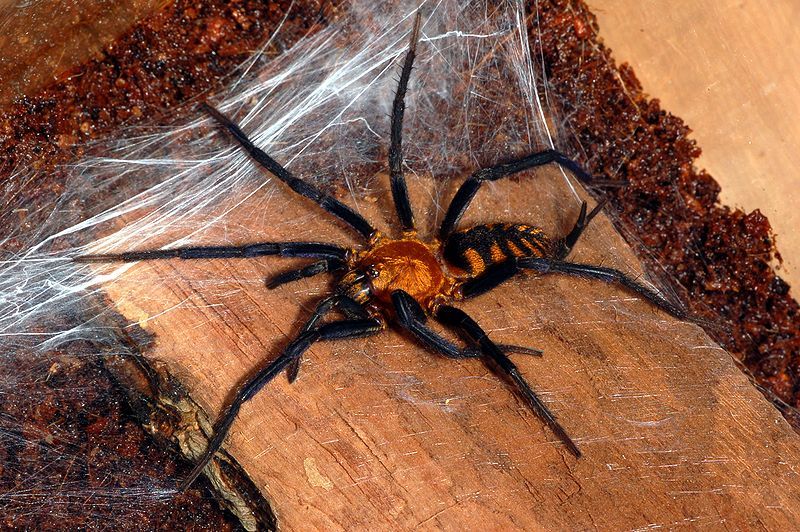
Arachnids: Amblypygids | Shit You Didn't Know About Biology

Arachnids.

Yes, arachnids; our eight-legged ?friends? that cling to the shadowy, forgotten corners of our homes, under the damp seal of a rock, to the harsh, hot crust of the desert, and to their feathery webs, crafted overnight in our gardens. Arachnids, as a group, are not at all unfamiliar to us humans, and while, overall, the relationship between ourselves and these ubiquitous invertebrates is a bit complex, by and large in Western culture, arachnids are feared and reviled. The most familiar groups of arachnids, spiders, scorpions, ticks, and mites, have earned reputations as some of the most terror-inducing, retch-provoking, and spine-shuddering animals we encounter in our day-to-day lives. We cringe at the thought of ticks embedded in our skin, face first, bodies inflating into pulsating balloons of blood. We attempt to ignore the unsettling fact that millions of microscopic mites graze on our dead skin cells, both separated from our bodies and still attached. We regard scorpions, prehistoric beasts made of plates, claws, stingers, and venom, as symbolic of the uninhabitable desert wilderness.

And then, of course, there are the oh-so common spiders, creatures who receive reactions from humans ranging from praise for their beautiful, radial web architecture, to mild annoyance when encountering a surprise face and mouthful of this same web on a forest trail, to revulsion and a swift, life-ending blow with a shoe or newspaper (turning the hapless critter into a drab smear of entrails), to blinding, full-on arachnophobic panic. These last group of arachnids, in particular, are the animal kingdom?s ?black sheep? in our culture, becoming a fixture in our conceptualization of the spooky atmosphere of Halloween; curiously, along with bats, spiders are among the few living, non-fictional entities we set alongside the stereotypical ghoulish folklore characters like zombies, skeletons, witches, and sundry other monsters. Apparently, we consider spiders among the creepiest, darkest, and most unnerving of all living things.Those that fear spiders, and creepy-crawly arachnids in general, cite these creatures? long, spindly limbs, soul-less eyes, hairy bodies, venomous fangs, fast movements, and a tendency to inhabit abandoned, abyssal areas where we are already at unease, as some the reasoning behind their prejudice. This instinctual aversion is strong enough, and prevalent enough, to inspire scores of films and literature where spiders are featured as agents of terror. Seriously. There are plenty. Of examples.?Our overwhelmingly negative view of spiders, especially, obscures some of their talents, many of which are immensely useful to humans. These include the production of a silk that is tougher than Kevlar (which has instigated research into super-strong materials), and an inarguably critical ecological role that keeps populations of their prey items (insects) in check. Spiders, like most arachnids, in the immortal words of Rodney Dangerfield, ?get no respect.?

Oh jeez. Are you guys happy now?

In the same way that spiders and other more familiar arachnids are misunderstood and have unrecognized, underappreciated roles in our lives, the very definition and realization of what arachnids, in the broadest sense,?actually are?typically is met with limited experience and knowledge. For example, most people, if prompted to ?name an arachnid? would answer firstly (overwhelmingly so) with ?spider.? Some might follow up with ?scorpion?, or perhaps ticks and mites?pretty much everything with eight legs and without insect-like antennae that comes to mind. However, the diversity of arachnids extends far beyond the web-bound orb weaver bobbing in the breeze in your front yard?s hedges, or the chigger causing lovely, itchy welts to form on your skin. While these groups are the most speciose, and most common accompaniment to our daily lives (good or bad), there are entire taxonomic orders of arachnids that go quite completely, and miserably, ignored.

This entry is to serve as the first in a series of explorations into the less-loved (or, perhaps, less-persecuted, simply out of unfamiliarity) arachnids.

But first, perhaps it is helpful to start with the following question: what is an arachnid, exactly?

The rule of thumb distinction between insects and arachnids, when trying to broadly identify a little, buggy critter with lots of legs, is the number of limbs, the number of body segments, and the presence or absence of antennae. This diagnostic method tends to work well in practice, but it doesn?t really inform?why?this distinction between the two types of animals is important, and the phylogenetic, evolutionary context.

Firstly, arachnids are members of the phylum Arthropoda (meaning ?jointed leg?). Essentially everything you find on this planet that has an exoskeleton, jointed appendages, and a segmented body is an arthopod; think insects, crabs, centipedes, shrimp, and the extinct trilobites. As far as animals are concerned, the vast bulk of them, both in number of species and number of individuals, are arthropods. There are over a million described species. If you were to randomly select a single species of animal on this planet, four times out of five that species would be an arthopod. When most people think of animals, furry mammals and other vertebrates instantly come to mind, but in reality, Earth is fucking covered in a tide of tiny, robot-like arthopods in all environmental realms.

Within this phylum are subdivisions, called ?sub-phyla? that break up the gargantuan number of arthropod species into about four living groups. One of these groups is the Chelicerata, which includes arachnids, but also includes living fossils like horseshoe crabs (obviously not true, crustacean crabs) and potentially an enigmatic, alien group of animals known as ?sea spiders? (although the classification on this group is constantly in review). It is the arachnids that make up the great majority of chelicerate diversity. Chelicerates are distinguished by the presence of unique pre-mouth appendages known as chelicerae, which have diversified into a wide range of morphologies, including the fangs of spiders, and pincer-like forms in most other members of this clade. Chelicerates also have appendages called pedipalps, which in more primitive groups are leg-like, but in ?higher chelicerates? have been modified into delicate sensory tools, organs used in reproduction, or weapons for defense or procuring food. Pedipalps can, with some reservation, be thought of as the chelicerate version of hands. Tiny, finger-less, hairy, creepy, jointed hands.

Arachnids, members of the class Arachnida, are the most prominent chelicerates (with more than 100,000 species), and have become by far the most successful group of chelicerate to colonize terrestrial ecosystems. This group, more or less, has two distinct body segments (called ?tagmata?); a cephalothorax (essentially the fusion of the head and thorax, typically covered by an unsegmented carapace), and the abdomen. The separation of these two tagmata can be stark, like in spiders, or more nuanced, like in ticks or scorpions.
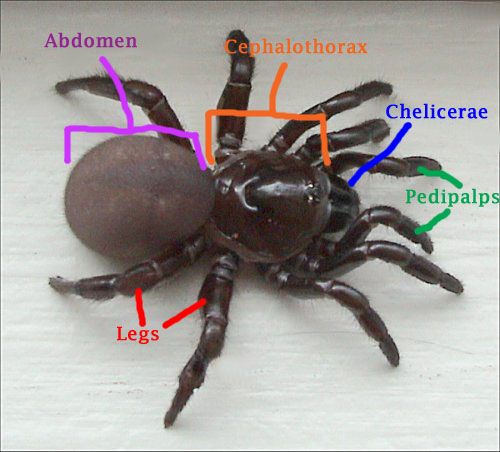
Not labeled: Horror genre marketability gland

The distribution of internal organs, and relative position of limbs, in this bi-segmented set-up that the arachnids have going on is a little hard to understand from our own vertebrate perspective. Imagine if you didn?t really have a neck, and your head sort of just continued on into your body, and if your arms and legs attached in this area right behind your head. Now, imagine if everything sort of pinched off behind your legs, and about 90% of all your major organ systems were packed into a bulbous mass sticking out beyond that ?waist? behind your head-legs. Oh, and you wouldn?t really have a ?normal? circulatory system, just a blood-filled cavity that sort of periodically dumped oxygenated blood on the other organs. This is known as an ?open circulatory system? and is typical of arthropods.

You?d be a horrific, human calabash?with limbs?and a hole leading to your lungs where your asshole should be. Your actual?anus would be on your lower back, right above your respiratory hole. So, holding your breath while taking a dump would be recommended. As if that wasn?t bizarre enough, under this configuration, you would have your?genitals positioned on your sternum.?You would probably find it hard to get a date.

Arachnids certainly don?t eat like we do either. The overwhelming majority of arachnid species are carnivorous, and tend to liquefy their prey items by injecting or covering them with digestive enzymes after capture. Only in a small minority of groups is the viscera-smoothie option rejected for the consumption of conventional, solid bits of food.

Reproduction and early life development in arachnids differs significantly from that of insects. Most of this difference comes in the lack of any kind of metamorphosis taking place in the development of young arachnids. Once arachnids are out of the egg, there?s no time for legless, lackadaisical, larval childhoods; they get right with the program and are born with the capacity for rapid movement (and within a short amount of time, the ability to kill food for themselves), being simply small, softer-bodied versions of adult arachnids. Anyone who has come across a mature spider egg sac and poked it with a stick is well-acquainted with the precociousness of hundreds of miniature, ghostly white, pollen grain-like babies, which quite suddenly engage in an exodus from their safe nursery?and onto the stick?and onto your hand.

Of those 100,000 arachnid species, 40,000 are found in the order that contains the spiders (Araneae). Another 30,000 are in the order belonging to mites and ticks (Acari). There are another 2,000 species of scorpion. Three-quarters of arachnid diversity is taken up by these three groups, but there are roughly a dozen orders within the arachnid class, and most of those remaining nine groups have species counts in the low hundreds, and don?t nearly get the publicity or exposure as a common barn spider or a deer tick.

The first of these neglected orders that will be addressed is the order Amblypygi, with its comparatively meager 136 described species. Pronunciation of this order?s name may conjure imagery of a sauntering swine, but the translation from Greek derives its true meaning?which is quite literally ?blunt ass? (amblyo- = dull, blunt, pygo- = rump). It seems like an oddly benign descriptor for an arachnid, especially when it?s for the entire taxonomic order. Perhaps, you think, it?s a stumpy, adorable sort of thing; the rare ?cute? arachnid. Surely, you say, that?s what the ?blunt butted? Amblypygi must consist of.

You were wrong.

This unholy combination of legs, spines, and the tears of small children is known as a ?tailless whip scorpion?, as well as a ?whip spider?, although it is neither a scorpion or a spider and is obviously far more terrifying than either of those things. This twisted creature appears to be molded out of the most unsettling portions of spiders, praying mantises, crabs, and daddy longlegs, but through the curious gestalt properties, is a uniquely hideous product of nature. You may recognize these animals as the ?spider? that was used in demonstration of the ?three unforgivable curses? in this scene in the film adaptation of ?Harry Potter and the Goblet of Fire??or, alternatively, in the worst dream you?ve ever had.

The ?whip? part of the name comes its first pair of legs, which have been modified into elongated, highly-sensitive, antennae-like probes. It is tempting to hypothesize that the function of these whips is for tickling the nose of sleeping humans so that they?ll open their mouths, allowing for this charmer to climb inside and lay its eggs in the back of the throat? but this is, fortunately, not the case. The whips are instead sensory organs, held far out in front of its body in order to detect anything worth snatching up for a meal. This includes crickets, beetles, caterpillars, and firstborn Egyptian sons.

It achieves this by use of its pedipalps, which you may have noticed have been modified into vicious, raptorial claws (?raptorial? typically referring to a limb that has underwent modifications for grasping prey). These long pedipalps, whose ends are densely studded with sharp, interlocking thorns, are kept tightly folded up against the gnashing chelicerae of the amblypygid, patiently awaiting some incredibly unlucky insect to cross its path. The pedipalps are also used in territorial displays against others of the same species, and amblypygids routinely extend and clash them against those of a transgressing individual (like bucks do with their antlers) in order to persuade them to step off their turf, whether their neighborhood is rich in mates or in prey.
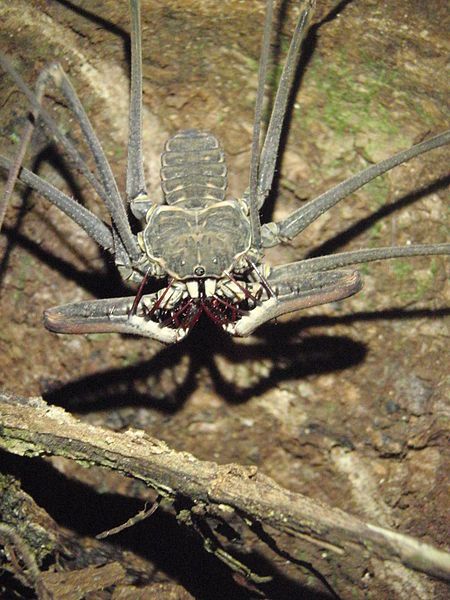
That sound you?re hearing is your bladder involuntarily emptying itself.

However, unless you are living in the tropical and subtropical regions of the world, you are unlikely to come across an amblypygid. Even if you were a resident of these warmer latitudes, you?d still have to search for these guys. They are usually nocturnal creatures, preferring to wedge their flattened bodies underneath wet logs, stones, or a piece of tree bark during the day?places where you really shouldn?t be putting your hands anyways while in the tropics. At night, they move silently and carefully along the rainforest floor, surveying their world by way of the delicate touch of their sensory legs. This is really the only way for them to interact with their environment, because amblypygids are really fucking blind. This may be a little surprising, considering that they have eight eyes; three grouped together on each side of the cephalothorax, and two more right in front on that raised bump that looks a bit like a nose.

If you were to somehow come across an amblypygid in the wild, you would have little to worry about. I can hear your incredulous gasps now, ?What? How can this be??Look?at this thing!? Amblypygids generally resemble what would come skittering out from between the dank, unwashed folds of a nightmare. They look like the voracious guardians of an ancient, booby trapped tomb in an Indiana Jones movie, or something that would hitch a ride across the galaxy on an asteroid, only to collide with Earth, scuttle out of the impact crater, and seek to take over the planet. If there was an organism banished to inhabiting the dark, dusty, cramped, lonely unknown of the area behind your washing machine, it would be an amblypygid. Surely, you protest, this spindly troglobitic creature, with its horrible claws, beady eyes, and all-feeling whips, bound to darkness and the humid, alien, subterranean world just below the forest undergrowth?must be deadly. Indeed, it must be a rabid, bloodthirsty monster; fangs overflowing with venom, legs taut with the anticipation of leaping and clinging to your face, spiky pedipalps itching to spring wide open and impart a puncturing embrace.
While the imagery of a company of ill-fated cave divers being feasted upon by hoardes of hyperaggressive, dinner plate-sized demon-spiders might seem appropriate for an animal as unsettling in aesthetics as the amblypygid (or for a low-budget, made-for-TV thriller; I?m looking at you Syfy)?but in reality, this scenario is an impossibility.

Observe, the horror that is an interaction between a human and a large amblypygid:

The person handling the amblypygid in the video above is by no means brave (so stop being impressed). The truth is, amblypygids are about as harmless as it gets for an arachnid. Their chelicerae are not the hollow, venom-engorged tubes found in the spiders, and the most danger to a human that comes from an amblypygid nip is a small amount of transient pain; like a mosquito bite with less itching. Just getting an amblypygid to engage in such behavior requires a great deal of pestering, as these creatures uniformly flee and seek refuge in tight, hard-to-access areas at the first annoyance. Defensive retaliation, a very rare occurrence, usually takes the form of a strike with those prickly pedipalps. This is kind of like getting smacked with a nail-bat?but with one only a couple inches long, probably doing about as much damage as a light brush with a thorny blackberry vine. Put simply, if an amblypygid decides to be uncharacteristically feisty with you, I?m pretty sure you?ll live.

Because of their docile temperament, combined with their intimidating appearance and size (some species can have leg-spans significantly wider than a human hand) amblypygids are reasonably popular as pets. Many other similarly-sized arachnids, like tarantulas and some larger scorpions, have a very real capacity to do some harm if handled improperly and/or given the opportunity to become aggressive. For example, some species of tarantula (only found in the New World), if threatened, will take a hind leg and quickly rub the top of the abdomen, kicking up a cloud of urticating hairs. These tiny, barbed hairs are incredibly irritating to human skin and mucous membranes, and if inhaled can cause potentially dangerous levels of airway inflammation; if the sharp hairs get embedded in the eyes, there is a substantial risk of partial or temporary blindness. Tarantulas can also plunge those giant fangs into human flesh as a defense mechanism, although this is rare. Unlike a nibble from the weak chelicerae of an amblypygid, a tarantula bite is not a walk in the park. You won?t die or get sick from the venom, but the sensation is a bit like being stabbed with a freshly sharpened pencil?on fire. Also, in the days following, the area of the bite swells up into a tender bubble of misery.
Scorpions, of course, have a whole suite of painful/deadly tools they can use on humans that I don?t think I need to go over.

Amblypygids easily achieve the ?wow? factor held by these other common arachnid pets (and then some), and bypass all of the risk of harm or death associated with ownership and handling.

We tend to view arachnids, and other exoskeletal, creepy-crawlies, as unthinking, anti-social automatons whose only function is to eat, avoid being eaten, and to make more of themselves. Often times, this assessment is somewhat accurate. Hell, the female representatives of many arthopod species (like spiders and praying mantises) routinely wolf down their bite-sized lovers without even batting a compound eye?because apparently that?s your only available post-coitus activity if you?re smaller than a cigarette. Some insects, like ants, termites, wasps, etc., form highly hierarchical societies and massive colonies of interdependent individuals, but this is an exception to the general rule in inter-arthropod relations. Tending to and caring for offspring beyond the egg stage isn?t ?a standard behavior, and communication between mothers (I say ?mother? because ?father? is probably currently in the process of being digested by ?mother?) and offspring is certainly limited. Let me put it this way: ?good parenting skills? in arthropod households typically consist of refraining from immediately eating more than half of your hatchlings?and that?s about it. There?s no way to get around it; arachnids and other arthropods are a cold, sociopathic bunch.

It may surprise you, given their off-putting, emotionless exteriors, that amblypygids are among the most socially savvy of all arachnid groups. Beneath that stiff, hard exoskeleton, amblypygids are, both literally and figuratively, big ol? softies.
While allowing newly-hatched young to piggyback for a little while is found in some arachnids (scorpions and some spiders do this, for example), the amount of care and interaction that amblypygids give their relatives is unusually high by arachnid standards.
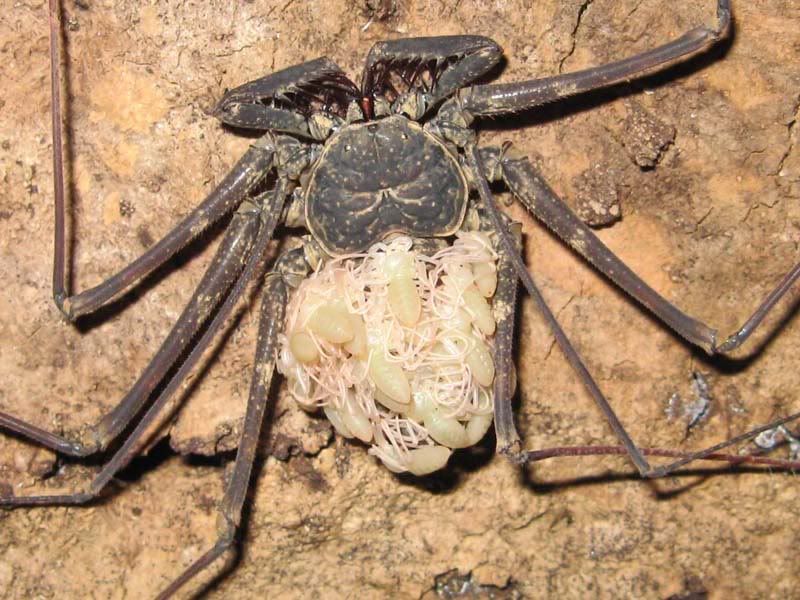
One-upping soccer moms for 400 million years

Research from entomologists at Cornell a few years back?on two species of amblypygid revealed that familial interaction in these arachnids might extend far beyond simple motherly protection and transport for squishy newborns. For example, mothers in these species keep their young (I like to call them ?amblypyg kids?) close by long after they were able to fend for themselves and get around on their own. Throughout the young?s pre-adult development, their mother caresses them with her sensitive whip legs, and the young reciprocate with their own sensory appendages. The young also interact with each other in this way; constantly petting each other with their whips. It?s as if they do this to soothe each other.

Yes, the scary, nasty-looking amblypygid is a cuddler.

Perhaps most strikingly, the young siblings of these species organize themselves into social groups all the way until reaching sexual maturity, which then immediately leads to combative, aggressive behavior towards each other. Anyone who experienced their teen years with siblings can probably identify with this phenomenon.
Up until this developmental stage (amblypygid puberty occurs roughly a year into their lives), the bonds formed between siblings and their mother are steadfast. If scattered and dropped into unfamiliar territory, the siblings feel around and seek each other out until they all re-group into one, big, happy family again. Of course, once the gonads kick into gear, family reunions result in unrepentant cannibalism. But, until then, brotherly and sisterly love are plentiful in an amblypygid?s world.

So, this concludes the introduction into one of the less acknowledged and less understood orders of arachnids. Despite their appearance, you certainly can?t judge amblypygids by their cover. For all their demonic homeliness and menacing first impressions, amblypygids are among the most amorous of the class Arachnida, both towards giant primates like ourselves, and uniquely towards members of their own brood. Perhaps if an animal with a brain smaller than a period on this page can learn to care for, and appreciate, other individuals in its species, we can somehow manage to do the same.

Image credits: Opening spider photo, source for arachnid diagram, Amblypygid #1, Amblypygid #2.

? Jacob Buehler and ?Shit You Didn?t Know About Biology?, 2012-2013. Unauthorized use and/or duplication of this material without express and written permission from this blog?s author and/or owner is strictly prohibited. Excerpts and links may be used, provided that full and clear credit is given to Jacob Buehler and ?Shit You Didn?t Know About Biology? with appropriate and specific direction to the original content.

Like this:

Like Loading...

Source: http://sydkab.wordpress.com/2013/02/23/arachnids-amblypygids-2/

Christmas Story after christmas sales case mccoy case mccoy UFC 155 Jack Klugman merry Christmas

U.S. Justice, Gulf states crafting BP spill settlement

(Reuters) - The U.S. government and Gulf Coast states are considering offering BP Plc a deal under which it pays $16 billion to settle civil suits stemming from the deadly 2010 Deepwater Horizon explosion and oil spill, the Wall Street Journal reported on Friday.

The deal would cover the company's potential penalties under the Clean Water Act and payments under the Natural Resources Damage Assessment, the newspaper said, citing sources familiar with the discussions.

It was unclear if the deal has been formally offered to BP. The U.S. Justice Department declined to comment.

A settlement could avert a bruising courtroom battle over the worst ever U.S. offshore oil spill slated to start on Monday in New Orleans, although the trial may begin as the terms of the deal are hammered out.

A settlement would also put a solid number on BP's costs under the Clean Water Act, which range from $4.5 billion to $17.5 billion, as well as potential natural resources damage assessments to the states under the Oil Pollution Act.

"BP doesn't talk about possible offers or negotiations, but I can tell you we are ready for trial and looking forward to the opportunity to present our case starting Monday," BP spokesman Geoff Morrell said when contacted by Reuters.

BP has spent or committed $37 billion on cleanup, restoration, payouts, settlements and fines. That includes an estimated $8.5 billion deal with most plaintiffs and a record $4.5 billion in penalties, and a guilty plea to 14 criminal counts to resolve criminal charges from the Justice Department and civil claims from the U.S. Securities and Exchange Commission.

BP has said it would settle on "reasonable terms," but was prepared to go to trial if the demands were "excessive and not based on reality."

(Reporting by Karl Plume in Chicago; Editing by Vicki Allen and Gunna Dickson)

Source: http://news.yahoo.com/u-justice-gulf-states-crafting-bp-oil-spill-164741968--finance.html

bradley cooper denver post Beasts of the Southern Wild Scandal denver broncos new england patriots Zayn Malik

Saturday, February 23, 2013

Facebook Graph API not returning friends' photos

Sorry, Readability was unable to parse this page for content.

Source: http://stackoverflow.com/questions/15045153/facebook-graph-api-not-returning-friends-photos

the forgotten man mike jones just friends chronicle george lopez bedtime stories micron

Nikola Stepić: The Wright/Knightley Trilogy

Anna Karenina, one of last year's most talked-about productions, is a product of a longstanding friendship between a director and his muse.

There is plenty that works in the newest adaptation of Leo Tolstoy's oft-told tale of a woman caught between rigid social norms and a passionate love that fails to transcend them. Joe Wright, the seemingly infallible filmmaking sensation who burst onto the scene in 2005 with his fresh take on Jane Austen's Pride and Prejudice, delivers a version of Anna Karenina that manages to sidestep that traditional (and dangerously reductive) martyr-whore dilemma. Conscious of the fact that most audiences know exactly where the story, and particularly the main character, is headed, he generously foreshadows Anna's demise by utilizing train imagery throughout the film, creating palpable tension that is so often absent in costume dramas based on literary classics. It also helps that Wright once again trusts his longtime muse Keira Knightley to embody Anna's fervor and petulance.

The relationship between Knightley and Wright harks back to that 2005 adaptation of Pride and Prejudice, the movie that cemented the young actress as a bona fide actress after Pirates of the Caribbean made her the rising movie star to look out for, and resulted in an Academy Award nomination for her portrayal of Elizabeth Bennet. Much of that film's popularity was surely due to the refreshing physicality of the production -- Wright set much of the movie outside, his characters threading through mud and morning mist, conversing in drawing rooms as well as in pigsties. The spectacularly lush cinematography that would become a staple of Wright's, along with wonderful production design, never took away from the gravity and humanness of the characters. The directorial debut was a good indicator of what Wright's career -- particularly his artistic marriage with Knightley -- would become: a visceral, stripped-down vision of glamor and opulence that works in support of the characters and never merely for its own sake. Even at the tender age of 18, Knightley was up for the challenge -- her Elizabeth Bennet embodied both the playful, young spirit of Austen's beloved heroine and her untamed intelligence that breaks through the barriers of normative behavior whenever she is affronted by the sullen Mr. Darcy.

Then came 2007's Atonement, the adaptation of the acclaimed Ian McEwan novel, and the second Wright-Knightley collaboration. Here, three generations of great actresses (Saoirse Ronan, Romola Garai and Vanessa Redgrave) playing the abominable Briony Tallis, one of today's great literary characters, utilized extraordinary tactility. In contrast, Knightley played the enigmatic heroine Cecilia in the most minimal, mythical way possible. All of the agency and quiet determination she had exhibited in Pride and Prejudice was now gone -- her character instead became the embodiment of a muse, the tragic, beautiful creature that Wright got to dress in the most fluid and delicately erotic of costumes, particularly the much-celebrated green dress that has since been called one of the greatest movie costumes of all time.

Which brings us to Anna Karenina, a film that could easily be considered the third part of a Wright-Knightley trilogy. Apart from the collaboration, the film marks the third time Wright is adapting a literary work of great celebrity and acclaim. It feels like a combination of the two movies preceding it. In a featurette released on the film's official YouTube channel, Wright justifiably calls Knigthley "utterly fearless." Indeed, there is a great visceral quality to her Anna, particularly in scenes that call for uninhibited emoting. However, this palpability of affectation is contained in a film of extraordinary fragility -- the decision to set the action on a stage that, throughout the film, morphs and sometimes disappears altogether, only to reappear in the most surprising of scenes, makes the relationship between the characters that much more theatrical and nuanced. The unusual setting not only allows Wright to lay the "all the world's a stage" metaphor quite heavily onto his audiences (and rightly so, for it could be argued that the story would take a fairly different turn if the characters weren't constantly on display, admired and judged in equal measure by the rest of the society), but it also gives a much-needed freshness to the story by framing it as a dazzling dream rather than the hard-hitting drabness that often represents Russia.

Other than Knightley's thoughtful, versatile performance as the volatile Anna, the film boasts other familiar faces. Matthew Macfadyen, Mr. Darcy to Knightley's Elizabeth Bennet, here plays Stiva Oblonsky, Anna's brother, and provides a nice societal contrast -- unlike Anna's, his infidelities go tolerated and unpunished. Aaron Taylor-Johnson infuses the film with a jolt of youthful energy in the role of dashing Alexei Vronsky, playing him as an antithesis to Jude Law's Karenin. Law, in turn, manages to steal the show, adding a layer of humanity to the emotionally barren character in spite of a somewhat flawed Tom Stoppard-penned script that tends to rush the proceedings before the emotional impact has fully registered with the audience. The nuanced performances, coupled with sumptuous costumes and Wright's whimsical and innovative direction, are reason enough to reignite our passion for Anna Karenina, despite the imminent fatality that too passionate a love may result in. Ultimately, it is a platform for Knightley to demonstrate both her commandeering screen presence and acute understanding of the character, complemented by Wright's dazzling spectacle.

?

"; var coords = [-5, -72]; // display fb-bubble FloatingPrompt.embed(this, html, undefined, 'top', {fp_intersects:1, timeout_remove:2000,ignore_arrow: true, width:236, add_xy:coords, class_name: 'clear-overlay'}); });

Source: http://www.huffingtonpost.com/nikola-stepic/the-wright-knightley-trilogy_b_2746461.html

weather san diego unitarian new black panther party lost in space elizabeth banks battle royale key largo

Is Taylor Swift's New Musical Bestie Tom Odell?

Swift partied backstage at the Brit Awards with singer/songwriter.
By Jocelyn Vena


Taylor Swift and Tom Odell
Photo: Getty Images

Source: http://www.mtv.com/news/articles/1702423/taylor-swift-tom-odell.jhtml

Tom Kenny Long Island Medium Alfonso Ribeiro adam sandler College Football Scoreboard nfl scores nfl scores

Friday, February 22, 2013

THE RESET: Obama, GOP battles don't affect Fed job

While the White House and Congress lurch combatively from one budget crisis to the next, another Washington institution has been bolstering the economy steadily and with little fanfare since the 2008 financial crisis began.

And the Federal Reserve seems likely to keep its stimulus pumps running at least awhile longer ? although minutes from a recent meeting show growing nervousness among U.S. central bankers over possible long-range harmful consequences, including steep inflation and instability in financial markets.

The Fed, under Chairman Ben Bernanke, has been keeping a key short-term interest rate near zero for over four years and is buying tens of billions of dollars in Treasury and mortgage bonds a month to keep downward pressure on longer-term interest rates and to provide liquidity to financial institutions.

Oh, and it's buying those bonds with money created out of thin air with the electronic equivalent of a printing press.

Minutes from the Fed's Jan. 29-30 policy meeting showed increasing debate over whether to end the huge stimulus sooner rather than later.

Still, the Fed voted 11-1 to continue its $85-billion monthly bond buying program for now.

However, the concerns were enough to drive European stocks sharply lower Thursday and contributed to a second day of declines for U.S. stocks ? even though there's scant evidence of rising inflation.

U.S. consumer prices were flat last month, a new government report shows, another sign inflation remains in check.

The latest crisis for President Barack Obama and Congress is the approach of deep, mandatory "sequester" spending cuts due to hit March 1 absent a bipartisan deficit-reduction deal. So far Republicans who lead the House have rejected Obama's insistence that any agreement be "balanced" with both spending cuts and increased tax revenues.

U.S. policymakers barely averted a "fiscal cliff" at the end of last year.

"Managing from crisis to crisis every 60 to 90 days is absurd," House Minority Whip Steny Hoyer, D-Md., said Thursday on MSNBC.

___

Follow Tom Raum on Twitter: http://www.twitter.com/tomraum

Source: http://news.yahoo.com/reset-obama-gop-battles-dont-affect-fed-job-173745176--politics.html

Tony Farmer West Nile virus symptoms snooki amy schumer amy schumer Prince Harry Vegas pictures Avril Lavigne

All the fun of the Fairtrade Fortnight with films, football and food

The first products labelled Fairtrade appeared on supermarket shelves in 1994 and now over 4,500 products are licensed to hold the Fairtrade label.

This move has benefited over seven million people in Africa, Asia and Latin America improving conditions for farmers who were exporting goods to the UK.

Edinburgh was awarded a Fairtrade status in 2004 and celebrates this award across the City through Fairtrade Fortnight.

The programme runs from February 25 to March 10 bringing together the public with businesses, producers and campaigners to promote awareness and sales of Fairtrade products through music, film, comedy and food.

Lord Provost Donald Wilson said: ?The packed programme of events planned for the next two weeks is testament to how far Fairtrade Fortnight in Edinburgh has come since we were awarded Fairtrade status in 2004.

?Through this campaign and the Lord Provost's Fairtrade Awards we are aiming to encourage more and more people to become ethical shoppers whilst also recognising the fantastic contribution that individuals and businesses are making to Fair Trade throughout Edinburgh.?

This year's theme is based around 'Go Further this Fairtrade Fortnight' aiming to highlight the need to think about where our food comes from.

The campaign aims to enforce the idea of a sustainable food system which works for everyone and ensures farmers get a profitable livelihood from the crops that they grow.

As well as an online campaign and petition, events will be held across the country to make the public aware.

Film Screenings

ReelReals: Steps in a world of equal exchange A series of short two minute films will be one a day over the fortnight via YouTube so you can join in the Fairtrade support straight from your home or on-the-go.

If you'd prefer a fuller experience, there will be a full showcase of all the films with refreshments at Summerhall on Sunday, March 10 from 4pm to 6pm.

The films contain interviews with farmers who grow Fairtrade and organic coffee, nuts and honey. You can watch the full journey of making the perfect Fairtrade coffee from bean to cup and see what customers think about Fairtrade products.

Comedy

The Scottish Fairtrade Benefit will take place on Tuesday, February 26 at The Stand. From 8.30pm stand-up comedians Phil Differ and Bob Doolally will help launch the fortnight with a show looking at child labour in the production of footballs. The show will herald Scotland's effort to become a Fairtrade football nation.

In-depth discussion

The Fairtrade Academic Network Seminar will invite Dr Alastair Smith from the University of Cardiff to discuss the meanings of Fairtrade. From 1pm to 2.30pm at the Chrystal Macmillan Building at the University of Edinburgh, the talk will look at the meanings of Fairtrade to the public and workers.

Fairtrade producer Tomy Matthew from India will present a talk at Edinburgh University Fairtrade cafe. The cafe won the Lord Provost Fair Trade Community Award in 2011. The talk will run from 12pm to 2pm and Tomy will be available to chat with the public before and after the event. Tomy is the founder and manager director of Elements India who exports organic coffee, cashews, peppercorns and other supplies. Places are free and booking is not required.

Sport

Edinburgh University will host a Fairtrade football match on Saturday, March 2 from 2pm to 4pm at the Meadows. Gather to watch students and staff from the University play five-a-side.

Fairtrade at the Meadows Marathon will take place on Sunday, March 3. The public can cheer on runners and Fairtrade bananas will be provided at Edinburgh University Teviot Dome for those taking part.

Food and Drink

A Fairtrade coffee morning will take place at Murrayfield Church Centre on Saturday, March 2. There will be a Fairtrade stall with a variety of items for sale, a children's craft corner and children's world teaching more about Fairtrade to a younger audience. The co-op smoothie bike will be on-hand allowing you literally cycle your way to a healthy drink. If you'd prefer something hot to drink, coffee will be on sale. The coffee morning will run from 10am to 12pm and entrance is ?2 for adults, children go free.

A Fairtrade wine tasting evening will take place from 7pm at The Priory Church in South Queensferry. The Queensferry Fairtrade group will offer a tasting of a selection of Fairtrade wines.

The main event

The Fairtrade Family fair and bruncheon will bring live music, free refreshments, talks, tasters of Fairtrade food and a range of activities to Out Of The Blue Drill hall on Saturday, March 9. The free event is for all ages and celebrates Edinburgh as a Fairtrade city. Live music on the day will come from Edimbira, music from Zimbabwe. Fairtrade items will be on sale throughout the day, the fair opens at 10.30am and runs until 2.30pm.

This event will also see the presentation of the 2013 Lord Provost Fair Trade Awards with four awards available. The Fair Trade Achievement Award, The Fair Trade School Award, The Fair Trade Newcomer Award and the Fair Trade Faith Community Award. Applications closed in January and the winners will be announced at the ceremony in Leith.

The Scotmid Co-operative will promote Fairtrade through local schools and the above community events.

Head of Corporate Communications for Scotmid Co-operative said: ?Fairtrade Fortnight is all about raising awareness of the difference we can make to millions of people in developing countries by simply supporting Fairtrade.

?Scotmid is proud to have been a champion of Fairtrade for many years. This fortnight we?ll be giving talks at local schools, holding Fairtrade events in our stores and supporting many other initiatives to educate people of all ages about why Fairtrade is so important.?

Related articles

Source: http://local.stv.tv/edinburgh/going-out/events-info/214942-fairtrade-fortnight-events-in-edinburgh/

snow white and the huntsman rupaul drag race walking dead comic kratom broncos broncos lehigh

PayrollHero Gets $1 Million In Seed Funding For Dev Efforts In Asia

Screen Shot 2013-02-21 at 1.36.29 PMWhen we first met PayrollHero.com, it was aiming to change the way small business timekeeping is done in Asia. With a $1 million seed round from 500Startups, LX Ventures, Futura, and others, it looks like they may do just that.

Source: http://feedproxy.google.com/~r/Techcrunch/~3/qe6iDd_Elgk/

sundance film festival the flintstones etta james ufc on fox evans vs davis fast times at ridgemont high fast times at ridgemont high

Friday, February 15, 2013

Jamie Dupree's Washington Insider: White House signals focus on economy

While there will certainly be more than one issue discussed by President Obama in Tuesday night's State of the Union Address, the White House made clear in recent days that the signature focus of this speech will be on the economy.

WASHINGTON (AP) -- President Barack Obama will focus his State of the Union address on boosting job creation and economic growth at a time of high unemployment, underscoring the degree to which the economy could threaten his ability to pursue second-term priorities such as gun control, immigration policy and climate change.

Last week, the President previewed the basic theme of his speech, telling House Democrats at a retreat that his political philosophy "starts with an economy that works for everybody."

Throughout my campaign, and throughout many of your campaigns, we talked about this bedrock notion that our economy succeeds and our economy grows when everybody is getting a fair shot and everybody is getting a fair shake and everybody is playing by the same rules. That we have an economy in which we?re growing a vibrant middle class -- that it grows from the middle out and the bottom up, not from the top down.

And over the next four years as I work with this caucus and every caucus, the question I will ask myself on every item, every issue is, is this helping to make sure that everybody has got a fair shot and everybody is doing their fair share, and everybody is playing by the same rules. Because I believe that is a growth agenda -- not just an equity agenda, not just a fairness agenda -- that is a growth agenda. That is when we have grown fastest.

And that means that what you?ll hear from me next week, I?m going to be talking about making sure that we?re focused on job creation here in the United States of America. (Applause.) It means that we?re focused on education and that every young person is equipped with the skills they need to compete in the 21st century. (Applause.) It means that we've got an energy agenda that can make us less dependent on foreign oil, but also that we?re cultivating the kind of clean energy strategy that will maintain our leadership well into the future.

It means that we?re going to talk about, yes, deficits and taxes and sequesters and potential government shutdowns and debt ceiling -- we?ll talk about that stuff, but all from the perspective of how are we making sure that somebody who works hard in this country -- a cop, or a teacher, or a construction worker, or a receptionist -- that they can make it if they work hard, and that their kids can make it and dream even bigger dreams than they have achieved.

But while the White House was handing out leaks in recent days that signaled a clear focus on economic issues, there was ample evidence of other issues that would be discussed as well - as some more liberal Democrats in Congress were making it clear what their top issue would be on Tuesday night - gun control.

"It is time to act on legislation to reduce gun violence," said Rep. Jim Himes (D-CT), one of several dozen House Democrats who will bring a victim of gun violence as a guest to the State of the Union Address.

Himes' guest, Katrina Murphy of Bridgeport, was walking with her 3-year old daughter last summer when they were caught in the crossfire of a gun battle; the young girl was wounded, but has now fully recovered.

Another Democrat doing the same is Rep. Jim Langevin (D-RI), who is bringing in the brother of a woman who was shot and killed during a convenience store robbery in Providence.

One would anticipate a Tuesday focus on the economy, gun violence, immigration reform, budget matters and more.

Whether it spurs activity in the Congress is another question.

Source: http://www.boortz.com/weblogs/jamie-dupree/2013/feb/10/white-house-signals-focus-economy/

meryl streep martin scorsese sacha baron cohen best picture nominees 2012 academy awards 2012 albert nobbs a star is born

Senate, White House struggle over Hagel impasse

WASHINGTON (AP) ? Struggling to break an impasse, Senate Democrats set a test vote Thursday on whether to advance Chuck Hagel's nomination as defense secretary after Republicans blocked speedy confirmation of their former colleague and Vietnam combat veteran.

Hours of behind-the-scenes talks yielded the decision by Senate Majority Leader Harry Reid, but no clear sign of whether President Barack Obama's nominee would receive the 60 votes required to move the Senate to a final vote on whether to confirm him. Democratic officials said the vote was scheduled with only a handful of votes needed to clear the threshold.

Sen. John McCain of Arizona led the opposition to Hagel's confirmation, but he said he would not object to the test vote, called cloture.

The remaining "yes" votes remain elusive, even after the White House responded to McCain's demand for information unrelated to Hagel. McCain and Sens. Lindsey Graham of South Carolina and Kelly Ayotte of New Hampshire said they would delay the vote until they got a more detailed accounting of Obama's actions on the night of the attack on the U.S. diplomatic mission in Benghazi, Libya, where Ambassador Chris Stevens and three other Americans were killed. Republicans have sought to portray Obama as being out of touch during the raid and demanded to know whether Obama spoke to any Libyan official during the Sept. 11 assault.

The Republicans' demand has had the effect of a filibuster.

The White House responded Thursday by saying former Secretary of State Hillary Clinton called Libyan President Mohamed Magariaf on Obama's behalf on Sept. 11 to coordinate additional support to protect Americans in Libya, White House counsel Kathryn Ruemmler wrote the senators. Obama spoke to Magariaf on the evening of Sept. 12, she said.

The Obama administration also had disclosed the calls at the time they were made.

A White House official said Thursday that if there had been a need to push the Libyans to do something, Obama would have called, but the official said the Libyans were trying to do the right thing and were being as helpful as possible. Moreover, the official, discussing internal communications only on the condition of anonymity, said the earlier call with Clinton had gone well.

Reid said it was "shocking" and "tragic" that the GOP would attempt to block Hagel's nomination at a time when the U.S. military is engaged in so many places around the world. "Not a single nominee for secretary of defense ever in the history of our country has been filibustered," he said in a speech on the Senate floor.

Reid said Republicans notified him Wednesday night they would withhold the votes needed to advance Hagel's nomination. Reid said he considered that a "full-scale filibuster" because the Republican strategy would prevent Hagel's nomination from getting the required 60 votes.

Republicans are seeking "extraneous requests" for information that will never be satisfied, Reid said. "The pattern has been clear for months: as soon as President Obama's administration responds to one request, Republicans devise another, more outlandish request," Reid said.

A full Senate vote on Hagel, a former two-term Republican senator from Nebraska and twice-wounded Vietnam veteran, was expected to be held Friday after Reid filed a motion to limit debate. While Democrats hold a 55-45 edge in the Senate and have the numbers to confirm Hagel on a majority vote, they need the support of five Republicans to clear the way for a majority vote.

Two Republicans ? Sens. Thad Cochran of Mississippi and Mike Johanns of Nebraska ? have announced their support for Hagel. A third, Sen. Susan Collins of Maine, has said she will vote against Hagel's confirmation, but would not join in a filibuster to block a final vote.

Graham said Wednesday that he would vote against ending debate on Hagel's nomination.

"There seems to not be much interest to hold this president accountable for a national security breakdown that led to the first ambassador being killed in the line of duty in over 30 years," Graham said. "No, the debate on Chuck Hagel is not over. It has not been serious. We don't have the information we need. And I'm going to fight the idea of jamming somebody through until we get answers about what the president did personally when it came to the Benghazi debacle."

McCain declined to say whether he would try to delay Hagel's confirmation if Obama did not provide an answer. "My position right now is I want an answer to the question," he said.

The nomination of John Brennan as CIA director is also being delayed; the Senate Intelligence Committee is pushing off a vote amid demands that the White House turn over more details about drone strikes against terror suspects and about the Benghazi attacks. Intelligence Committee Chairwoman Dianne Feinstein of California said a vote likely will be postponed till late February.

A bitterly divided Armed Services Committee on Tuesday voted to approve Hagel by a 14-11 vote, with all the panel's Democrats backing him. The committee's Republicans were unified in opposition to their onetime colleague, who will succeed Defense Secretary Leon Panetta if he's confirmed.

Obama "stands strongly" behind Hagel and believes he "will do a wonderful job," White House spokesman Josh Earnest said aboard Air Force One en route to Decatur, Ga., where the president traveled Thursday to speak about early childhood education.

If confirmed by the Senate, Hagel, 66, would take charge of the U.S. armed forces at a time of turmoil. Automatic cuts to the Pentagon's budget are looming, American troops in Afghanistan are being halved over the next year, North Korea has tested a nuclear weapon, Iran remains a threat in the Persian Gulf region, and Syria, Iraq, Libya, Egypt, Mali and Tunisia all are in a state of unrest.

At a Pentagon award ceremony on Thursday for former Secretary of State Hillary Rodham Clinton, Panetta said it was fitting to recognize her accomplishments on Valentine's Day. And he said the second-best Valentine's Day present would be for the Senate to confirm Hagel and allow Panetta and his wife to "get the hell out of town." He said he's got his belongings packed.

Hagel has faced intense opposition from Republicans, who have challenged his past statements and votes on Israel, Iran, Iraq and nuclear weapons.

___

Associated Press writers Alan Fram, Donna Cassata and Jim Kuhnhenn contributed to this report.

_____

Online:

Sen. Susan Collins: http://www.collins.senate.gov/public/

Source: http://news.yahoo.com/senate-white-house-struggle-over-hagel-impasse-193158036--politics.html

evan mathis staff sgt. robert bales jason russell norfolk state st patrick s day parade duke invisible children

Are billboards driving us to distraction?

Feb. 14, 2013 ? There's a billboard up ahead, a roadside sign full of language and imagery. Next stop: the emotionally distracted zone.

One University of Alberta researcher has discovered that language used on billboards can provoke an emotional response that affects our driving abilities. And whether the words have a negative or positive connotation seems to determine whether the attention wanders or the foot gets heavier.

Lead study author Michelle Chan says that although plenty of literature exists on road rage, none of it deals with external emotional stimuli. Chan and her U of A co-author, psychology professor Anthony Singhal, devised an experiment using a driving simulator. Participants drove through one of three scenarios that exposed them to 20 billboards on the course; each billboard contained blocks of words that were positive, negative or neutral in nature. They were also tested for response by having to push a button on the steering wheel when they encountered a target word.

"Studies have shown that when subjects see an emotional stimulus as opposed to a neutral one, they're slower in making reaction time responses and they're slower when doing a visual search," said Chan. "I wanted to see whether the results would carry over in driving -- would we also find more distracted performance in driving? -- and we did see that."

Emotionally charged words affected the subjects' driving focus, something that may make driving in real conditions hazardous. Chan says that subjects who viewed the negative words decreased travelling speed when passing the signs and tended to drift and veer from their lane. Conversely, drivers viewing the words with positive connotations sped up when passing the signs -- a response the researchers said supported other research.

"There have been studies showing that when you're positively stimulated, your attention broadens, so you perform better when you're in a happy mood," said Chan. "In my results, we also saw that when we looked at the reaction-time data in response to target words, participants actually responded faster in the positive block than in the negative block."

Chan says a precedent already exists Down Under for dealing with this type of distraction, but some places may be harder to convince than others.

"In Australia they have really strict billboard criteria, but in the United States it's less so," she said. "When you're driving in Las Vegas, you'll see a bunch of profane billboards. There are also some really graphic anti-smoking billboards around."

Chan contends that emotional distraction while driving may come from anything from music to news to conversations, so it would be hard to legislate against those types of factors. Self-regulation on the images and language marketers use on billboards could be one way to reduce potential for emotionally related vehicular incidents.

Ultimately, she says, drivers need to take responsibility for their actions behind the wheel, even if it meets reducing the usual driving stimuli such as talking or listening to the radio.

"Any kind of distraction is risky when you're driving. But there would appear to be a larger risk when it comes to emotional stimuli."

Share this story on Facebook, Twitter, and Google:

Other social bookmarking and sharing tools:


Story Source:

The above story is reprinted from materials provided by University of Alberta, via EurekAlert!, a service of AAAS.

Note: Materials may be edited for content and length. For further information, please contact the source cited above.


Note: If no author is given, the source is cited instead.

Disclaimer: This article is not intended to provide medical advice, diagnosis or treatment. Views expressed here do not necessarily reflect those of ScienceDaily or its staff.

Source: http://feeds.sciencedaily.com/~r/sciencedaily/mind_brain/child_development/~3/ijSujPy23AQ/130214134024.htm

Lynsi Torres Fall Out Boy Alabama hostage mta Beyonce Superbowl weather.com nemo

Red brain, blue brain: Republicans and Democrats process risk differently, research finds

Feb. 13, 2013 ? A team of political scientists and neuroscientists has shown that liberals and conservatives use different parts of the brain when they make risky decisions, and these regions can be used to predict which political party a person prefers. The new study suggests that while genetics or parental influence may play a significant role, being a Republican or Democrat changes how the brain functions.

Dr. Darren Schreiber, a researcher in neuropolitics at the University of Exeter, has been working in collaboration with colleagues at the University of California, San Diego on research that explores the differences in the way the brain functions in American liberals and conservatives. The findings are published Feb. 13 in the journal PLOS ONE.

In a prior experiment, participants had their brain activity measured as they played a simple gambling game. Dr. Schreiber and his UC San Diego collaborators were able to look up the political party registration of the participants in public records. Using this new analysis of 82 people who performed the gambling task, the academics showed that Republicans and Democrats do not differ in the risks they take. However, there were striking differences in the participants' brain activity during the risk-taking task.

Democrats showed significantly greater activity in the left insula, a region associated with social and self-awareness. Meanwhile Republicans showed significantly greater activity in the right amygdala, a region involved in the body's fight-or-flight system. These results suggest that liberals and conservatives engage different cognitive processes when they think about risk.

In fact, brain activity in these two regions alone can be used to predict whether a person is a Democrat or Republican with 82.9% accuracy. By comparison, the longstanding traditional model in political science, which uses the party affiliation of a person's mother and father to predict the child's affiliation, is only accurate about 69.5% of the time. And another model based on the differences in brain structure distinguishes liberals from conservatives with only 71.6% accuracy.

The model also outperforms models based on differences in genes. Dr. Schreiber said: "Although genetics have been shown to contribute to differences in political ideology and strength of party politics, the portion of variation in political affiliation explained by activity in the amygdala and insula is significantly larger, suggesting that affiliating with a political party and engaging in a partisan environment may alter the brain, above and beyond the effect of heredity."

These results may pave the way for new research on voter behaviour, yielding better understanding of the differences in how liberals and conservatives think. According to Dr. Schreiber: "The ability to accurately predict party politics using only brain activity while gambling suggests that investigating basic neural differences between voters may provide us with more powerful insights than the traditional tools of political science."

Share this story on Facebook, Twitter, and Google:

Other social bookmarking and sharing tools:


Story Source:

The above story is reprinted from materials provided by University of Exeter, via EurekAlert!, a service of AAAS.

Note: Materials may be edited for content and length. For further information, please contact the source cited above.


Journal Reference:

  1. Darren Schreiber, Greg Fonzo, Alan N. Simmons, Christopher T. Dawes, Taru Flagan, James H. Fowler, Martin P. Paulus. Red Brain, Blue Brain: Evaluative Processes Differ in Democrats and Republicans. PLoS ONE, 2013; 8 (2): e52970 DOI: 10.1371/journal.pone.0052970

Note: If no author is given, the source is cited instead.

Disclaimer: This article is not intended to provide medical advice, diagnosis or treatment. Views expressed here do not necessarily reflect those of ScienceDaily or its staff.

Source: http://feeds.sciencedaily.com/~r/sciencedaily/top_news/~3/Z5y-fbe3PzM/130213173131.htm

Valentines Day Quotes cnn Affenpinscher kate middleton state of the union paczki fat tuesday

Thursday, February 14, 2013

Cheap, strong lithium-ion battery developed

Wednesday, February 13, 2013

Researchers at USC have developed a new lithium-ion battery design that uses porous silicon nanoparticles in place of the traditional graphite anodes to provide superior performance.

The new batteries?which could be used in anything from cell phones to hybrid cars?hold three times as much energy as comparable graphite-based designs and recharge within 10 minutes. The design, currently under a provisional patent, could be commercially available within two to three years.

"It's an exciting research. It opens the door for the design of the next generation lithium-ion batteries," said Chongwu Zhou, professor at the USC Viterbi School of Engineering, who led the team that developed the battery. Zhou worked with USC graduate students Mingyuan Ge, Jipeng Rong, Xin Fang and Anyi Zhang, as well as Yunhao Lu of Zhejiang University in China. Their research was published in Nano Research in January.

Researchers have long attempted to use silicon, which is cheap and has a high potential capacity, in battery anodes. (Anodes are where current flows into a battery, while cathodes are where current flows out.) The problem has been that previous silicon anode designs, which were basically tiny plates of the material, broke down from repeated swelling and shrinking during charging/discharging cycles and quickly became useless.

Last year, Zhou's team experimented with porous silicon nanowires that are less than 100 nanometers in diameter and just a few microns long. The tiny pores on the nanowires allowed the silicon to expand and contract without breaking while simultaneously increasing the surface area ? which in turn allows lithium ions to diffuse in and out of the battery more quickly, improving performance.

Though the batteries functioned well, the nanowires are difficult to manufacture en masse. To solve the problem, Zhou's team took commercially available nanoparticles?tiny silicon spheres?and etched them with the same pores as the nanowires. The particles function similarly and can be made in any quantity desired.

Though the silicon nanoparticle batteries currently last for just 200 recharge cycles (compared to an average of 500 for graphite-based designs), the team's older silicon nanowire-based design lasted for up to 2,000 cycles, which was reported in Nano Lett last April. Further development of the nanoparticle design should boost the battery's lifespan, Zhou said.

"The easy method we use may generate real impact on battery applications in the near future," Zhou said.

Future research by the group will focus finding a new cathode material with a high capacity that will pair well with the porous silicon nanowires and/or porous silicon nanoparticles to create a completely redesigned battery.

###

University of Southern California: http://www.usc.edu

Thanks to University of Southern California for this article.

This press release was posted to serve as a topic for discussion. Please comment below. We try our best to only post press releases that are associated with peer reviewed scientific literature. Critical discussions of the research are appreciated. If you need help finding a link to the original article, please contact us on twitter or via e-mail.

This press release has been viewed 41 time(s).

Source: http://www.labspaces.net/126760/Cheap__strong_lithium_ion_battery_developed

staff sgt. robert bales jason russell norfolk state st patrick s day parade duke invisible children garbage pail kids

Apple finishes in first place over 2012 in Japan?s mobile phone market

iPhone 5 feature

Historically, Japan has been a tough place for phone manufacturers to gain any traction. It was always seen as being an isolated island where technology was so far ahead of what the West was using, to attempt to break that market was seen as foolish. That said, Apple partnered with Softbank, and launched. The following for Apple?s iPhone in the country is so large now, that it?s generally always among the first group of countries to get a new iDevice on launch day. 2012?s results are evidence of that success.

Counterpoint Research as done some analysis of the market, and discovered that Apple was the most popular phone manufacturer in Japan over 2012. Not just smartphones, mobile phones in general. Thanks to a great end of year launch for the iPhone 5, Apple finished with 15% of the entire mobile market. The usual suspects, Sharp and Fujitsu, were just behind, each with around 14% of the market. Before Apple?s success, Sharp had been Japan?s top manufacturer for the past 6 years on the trot.

It appears the Japanese market is shifting in favor of the iPhone. It?ll be interesting to see how other manufacturers respond.

Source: Counterpoint
Via: TheNextWeb

Source: http://feedproxy.google.com/~r/TodaysIphone/~3/ZgTUK9dWeug/

binder full of women Microsoft Surface Candy Crowley binders of women Alexis Wright presidential debates Felix Baumgartner

Wednesday, February 13, 2013

Online Education Project Manager ? The Institute for the

This is a syndicated post from CatholicJobs.com. [Read the original article...]

ONLINE EDUCATION PROJECT MANAGER
Sales, FT Employee
The Institute for the Psychological Sciences (Arlington, VA)

The Institute for the Psychological Sciences

Online Education Project Manager

The Institute for the Psychological Sciences in Arlington, VA invites applications for a full-time Online Education Project Manager position. The Institute for the Psychological Sciences is a free-standing Catholic professional school offering degrees in clinical psychology and has recently begun an online distance education program. (www.ipsciences.edu)

The Online Product Manager (OPM) drives revenue for the IPS online product and /or brand. The OPM reports directly to the Director of Distance Learning and oversees the sales and marketing of the online IPS products throughout the product life cycle. This position requires a unique combination of sales, marketing, product management and in some cases technical skills to drive revenue for the online offering.

Primary Duties and Responsibilities:

o Develop and implement go-to-market plans for online continuing education, certificate and other programs.

o Creating sales budgets and quotas in conjunction with the Dir., Online Learning and Sr. Management team.

o Achieving monthly sales quotas.

o Developing both online and offline marketing approaches not limited to partnerships, promotions, strategic alliances, ad campaigns.
- Overseeing the development and marketing of a product through its life cycle includes working with designers, financial managers and faculty and partners to develop a product to meet customers? needs and interests. This can involve strategic analysis and research to understand the needs of customers or the market opportunity.

o Analysis and research regarding product competitors and potential customers to provide a marketing plan and message for each product, webinars, CE?s, Certificate programs, etc. After careful analysis, pricing is set for the product to meet profitability goals for the organization.

o Develops sales tools and educates partners/affiliates about the product and its most valuable sales approach. The product manager also conducts customer sales calls in person , via the telephone and online sales meetings to ensure sales goals are being met. This can include receiving customer feedback and providing product improvement/enhancement feedback to the Director, Online Learning if necessary.

o Provide daily and weekly reports to include sales calls, sales closed, visits, etc.

Necessary Skills and Abilities:

Educational requirements include a bachelor?s degree and at least three years experience in marketing, sales, or product management.

This is a salary plus commission position. Compensation is based on experience and performance. Willingness to travel up to 25% of time, both nationally and internationally.

Send cover letter and resume to [email?protected] (28)


Source: http://www.dfwcatholic.org/online-education-project-manager-the-institute-for-the-psychological-sciences-arlington-va-82728/.html

Hunter Pence NBCOlympics Danell Leyva Ye Shiwen OJ Murdock Olympics Live Mens Gymnastics

Tuesday, February 12, 2013

What the Dalai Lama said about the India rape case at the Jaipur Literature Festival

The Dalai Lama made his first ever appearance at Asia's biggest literary festival and was promptly pressed by reporters about the Delhi rape case.?

By Fahad Shah,?Contributor / January 25, 2013

The Dalai Lama speaks on the opening day of India's Jaipur Literature Festival in Jaipur, India, Thursday.

Deepak Sharma/AP

Enlarge

Crowds lined his path and leaned off arched terraces to catch a glimpse of the Dalai Lama at his first ever appearance at the Jaipur Literature Festival.?The annual gathering, Asia's largest, of literati in this city of desert palaces has begun to attract global celebrities in recent years,?with even Oprah Winfrey holding court here last year.

Skip to next paragraph

Recent posts

' + google_ads[0].line2 + '
' + google_ads[0].line3 + '

'; } else if (google_ads.length > 1) { ad_unit += ''; } } document.getElementById("ad_unit").innerHTML += ad_unit; google_adnum += google_ads.length; return; } var google_adnum = 0; google_ad_client = "pub-6743622525202572"; google_ad_output = 'js'; google_max_num_ads = '1'; google_feedback = "on"; google_ad_type = "text"; google_adtest = "on"; google_image_size = '230x105'; google_skip = '0'; // -->

The Tibetan spiritual leader addressed a crowd of about 4,000 in a conversation with his biographer Pico Iyer.?

Calling the 20th century a century of bloodshed and violence, the Dalai Lama urged that the ?21st century be a century of dialogue.? The title of his talk, "Kinships of Faiths: Finding the Middle Way," headlined his hopes for comity even in the potential divisive realm of religion.?

In his words, secularism is mostly misunderstood as being against religion. He said in India every religion is respected and our fore fathers framed the constitution of India by keeping space for every religion. "There are so many religions in India but the country is stable," he said.

The Delhi rape case came up, when a reporter asked his view on the Indians demanding capital punishment for the rapists.

"I have been noticing crimes in big cities like Bombay and Delhi? when these kinds of things happen people take it for granted. Now the time has come that we must make efforts for special protection to women, physically and men?s protection is education," said the Dalai Lama.?
The rape case trial opened yesterday. Before the trial opened Indians were debating whether the accused should be chemically castrated or even put to death if found guilty. The Dalai Lama expressed his dislike of capital punishment. ?Since many decades Amnesty International started a movement banning death sentence. I signed it. I do not like death penalty but it is up to the country's law to decide,? he told the reporters after his session.
He also asserted that the independent Tibet should be a secular and democratic country. The Dalai Lama spoke about the China-Tibet dispute, although conceding that he has now retired from his political role. He urged good relations between India and China are must as they are the ?most populous nations in the world? and put forth India as an example for China to learn to be democratic.
This year 285 speakers will be speaking during the five day schedule. Last year, around 120,000 people had attended the five day festival.?

Source: http://rss.csmonitor.com/~r/csmonitor/globalnews/~3/VndtUKj_Sc0/What-the-Dalai-Lama-said-about-the-India-rape-case-at-the-Jaipur-Literature-Festival

masters winner instagram facebook mike wallace mike wallace chicago cubs split pea soup recipe the client list